Volcanoes National Park Rwanda
VOLCANOES NATIONAL PARK
History
The park was first gazetted in 1925, for a small area surrounded by Karisimbi, Bisoke and Mikeno, made to protect the gorillas from poaching. It was the absolutely first National Park to be created in Africa. Subsequently, in 1929, the borders of the park were broadened further into Rwanda and into the Belgian Congo, to form the Albert National Park, a large area of 8090 km², run by the Belgian colonial authorities who were in control of both colonies.
After the Congo gained independence in 1960, the park was split into two, along with upon Rwandan independence in 1962 the new government agreed to maintain the park as a conservation along with tourist area, despite the fact that the new republic was already affected by overpopulation problems. The park was halved in area in 1969.
Diana Fossey: Gorillas in the Mist
The park later on became the base for the prominent American naturalist Dian Fossey to carry out her research into the gorillas. She arrived in 1967 as well as set up the Karisoke Research Centre between Karisimbi as well as Bisoke. From then on she spent most of her time in the park, furthermore is widely credited with saving the gorillas from extinction by bringing their plight to the attention of the international community. She was assassinated by unknown assailants at her home in 1985, a crime often attributed to the poachers she had spent her life fighting against.
Fossey’s life later on was presented on the big screen in the film Gorillas in the Mist. She is buried in the park in a grave about to the research center, and amongst the gorillas which became her life.
The Volcanoes National Park became a battlefield in the course of the Rwandan Civil War, with the park headquarters being attacked in 1992. The research centre was vacated, along with all tourist activities (including visiting the gorillas) were stopped. They did not resume again until 1999 when the area was deemed to be secure as well as under control. There have been occasional infiltrations by Rwandan rebels from the Democratic Forces for the Liberation of Rwanda in subsequent years, although these are often stopped quickly by the Rwandan army and there is thought to be no threat to tourism in the park.
Flora
Vegetation varies considerably as a result of the large altitudinal range within the park. There is some lower montane forest (now basically lost to agriculture). Between 2400 and 2500 m, there is Neoboutonia forest. From 2500 to 3200 m Arundinaria alpina (bamboo) forest occurs, covering approximately 30% of the park area. From 2600 to 3600 m, mainly on the more humid slopes in the south as well as west, is Hagenia-Hypericum forest, which covers about 30% of the park. This is one among the biggest forests in Africa with Hagenia abyssinica. The vegetation from 3500 to 4200 m is defined by Lobelia wollastonii, L. lanurensis, and Senecio erici-rosenii and covers about 25% of the park. From 4300 to 4500 m grassland occurs. Secondary thicket, meadows, marshes, swamps as well as small lakes as well occur, although their total area is relatively small.
Fauna
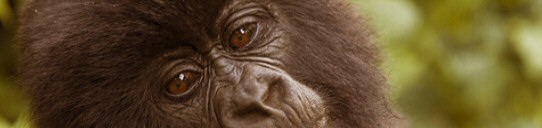
The park is known for the Mountain Gorilla (Gorilla beringei beringei). Other mammals include: golden monkey (Cercopithecus mitis kandti), black-fronted duiker (Cephalophus niger), buffalo (Syncerus caffer), Spotted Hyena (Crocuta crocuta) and bushbuck (Tragelaphus scriptus). There are as well reported to be some elephants in the park, even though these are now absolutely rare
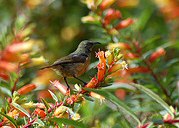
There are 178 recorded bird species, with at least 13 species and 16 subspecies endemic to the Virunga and Ruwenzori Mountains.
Tourists activities
• Gorilla visits
• Golden monkey visits.
• Climbing of Karisimbi volcano with an altitude of 3,800 m.
• Climbing of Bisoke volcano.
• Tour of the lakes and caves.
• Visiting the tomb of Dian Fossey.
Section: Parc National Des Volcans |